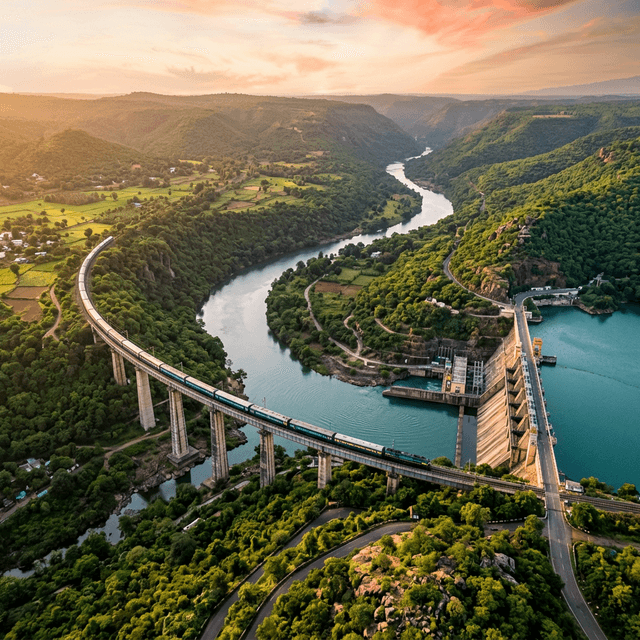
Both UAV photogrammetry and UAV LiDAR produce spatial data from the air. But they are fundamentally different technologies — with different strengths, limitations, and ideal applications. This white paper provides a head-to-head evaluation for Indian infrastructure survey contexts.
How Each Technology Works
UAV Photogrammetry
- Camera captures overlapping NGB or RGB images
- Structure from Motion (SfM) algorithm computes 3D point positions from image overlap
- Accuracy depends on GCP distribution and image quality
- Produces dense colour point cloud and textured mesh
- GSD typically 2–10cm depending on flight altitude
UAV LiDAR
- Active laser pulses measure time-of-flight to surface
- Each pulse returns intensity value + XYZ coordinate
- Multiple returns capture vegetation and ground simultaneously
- Accuracy depends on IMU/GNSS quality and scan rate
- Point density typically 200–2000 pts/m² depending on speed/altitude
Head-to-Head Comparison
| Criterion | UAV Photogrammetry | UAV LiDAR |
|---|---|---|
| Point Density | 50–200 pts/m² (UAV photogrammetry) | 500–2000 pts/m² (UAV LiDAR) |
| Accuracy (vertical) | ±5–15cm (GCP dependent) | ±3–5cm (RTK/PPK) |
| Under-canopy penetration | None (RGB only) | Partial (multi-return enables ground) |
| Texture / colour data | Full RGB photorealistic texture | Intensity only (colourized via sync camera) |
| Cost | Lower — sensor cost & mobilisation | Higher — specialist payload and processing |
| Processing time | Faster (photogrammetry is well-automated) | Slower (classification and noise filtering) |
| Adverse weather performance | Wind-sensitive; poor in rain or haze | Active sensor — performs better in dust/haze |
| Structural / infrastructure detail | Good for surfaces, poor for underside geometry | Excellent — captures bridge undersides, tunnel linings |
Decision Guide for Indian Projects
Choose UAV Photogrammetry when:
- Budget is a primary constraint
- Deliverable is an orthomosaic or textured 3D model for visual inspection or stakeholder communication
- Project site is open terrain with no vegetation or underbridge geometry
- Repeat monitoring with visual change detection is required
Choose UAV LiDAR when:
- Survey-grade accuracy is required for engineering use (±5cm or better)
- Terrain has vegetation and you need bare-earth DEM
- Project involves bridges, culverts, or any structure with complex underside geometry
- Conditions are dusty, partially hazy, or require night-time operation
Use Both (Hybrid Survey):
- Large infrastructure DPR requiring both terrain DEM and photorealistic visualization
- Bridge projects requiring underside LiDAR and textured surface models for client reports
- Heritage corridor mapping requiring sub-cm accuracy and colourized point clouds
The GESIX Recommendation
For Indian infrastructure survey, we recommend defaulting to UAV LiDAR for any project where the data will be used for engineering design or asset management decisions. The accuracy and structural penetration advantages justify the cost premium. Photogrammetry is appropriate for desktop visualization, stakeholder reporting, and large-area reconnaissance surveys where engineering accuracy is not the primary objective.