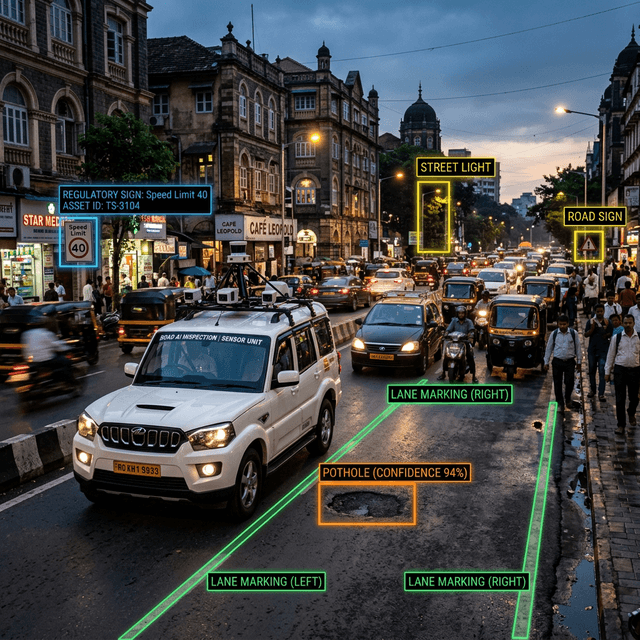
A state PWD in central India needed a complete road asset inventory across a 200 km urban road network — including pavement condition, roadside furniture, drainage, and signage — in under a month. Manual survey would have taken six. Here is how GESIX delivered it in three weeks using mobile LiDAR and AI.
The Brief
The client — a municipal corporation managing roads across a tier-2 Indian city — had never completed a systematic inventory of its road network. Maintenance was reactive: potholes were reported by residents, signs were replaced only after complaints, and drainage structures were unknown. The corporation had received a central government Smart City grant that required a geo-referenced, queryable asset database as a prerequisite for fund release. Deadline: 21 working days.
The Technology Stack
Mobile LiDAR Platform
Vehicle-mounted LiDAR (2 × 32-beam rotating LiDAR heads) scanning at 600,000 pts/sec. Synchronized with dual GNSS CORS and IMU for seamless absolute positioning without GCPs.
360° Camera Array
5 × 8MP wide-angle cameras mounted on vehicle roof for full panoramic road surface and roadside asset capture at 5cm/pixel resolution at 50 km/h.
AI Detection Engine
GESIX custom-trained convolutional neural network (CNN) detecting 14 asset classes — potholes, cracking, road markings, signs, guardrails, manholes, trees — with 91% mean average precision.
GIS Delivery Platform
ESRI ArcGIS Enterprise deployment with custom road asset schema, PCI calculation module, and integration with the client's existing Municipal GIS.
Execution — Week by Week
Mobile Survey Deployment
Mobile LiDAR van completed 200 km of road network coverage across 4 working days — averaging 50 km/day at survey speed. Night-time resurfacing routes surveyed after 10pm to avoid traffic disruption. Raw LiDAR and imagery: 1.4 TB of data.
AI Processing & Classification
Automated AI pipeline processed the full 200 km dataset: pavement defect detection, road sign classification, and roadside asset extraction ran in parallel on GPU cluster. Manual QA team reviewed AI outputs and corrected <8% error cases.
GIS Integration & Report Generation
Spatial data loaded into ArcGIS. PCI scores computed per 10m road segment. Asset database exported to compatible schema. Final PDF report with heat maps, top-10 priority segments, and budget estimate submitted to client.
Results
200 km
Network Surveyed
14,847
Assets Inventoried
2,341
Pavement Defects Mapped
91%
AI Detection Accuracy
The client received a complete, GIS-ready asset database within 21 working days — enabling successful grant claim and forming the baseline for the Smart City road maintenance programme. Critically, 34% of the mapped pavement defects and 28% of the sign deficiencies were unknown to the corporation prior to the survey — confirming the inadequacy of complaint-based maintenance.
What This Means for Indian Municipalities
Urban local bodies across India manage road networks with little to no systematic spatial data. The combination of mobile LiDAR and AI makes comprehensive road asset inventories economically viable for tier-2 and tier-3 cities for the first time. The data produced is not just for compliance — it is a planning instrument. Maintenance budgets allocated against objective PCI data consistently outperform those based on political priority or reactive complaint.